
You rank number one.From your own driveway.
The map pack is calculated from wherever the customer is standing, not from your office. Check your rankings at the shop and you will look like the market leader. Drive three miles and you may not appear at all. Almost every contractor is measuring the one spot on the map where they are guaranteed to look good.
Source: SearchLight Digital contractor advertising benchmarks, February 2026, drawn from $6.72M in tracked Local Services Ads spend across 888 contractors, and January 2026 Google Ads benchmarks across 816 contractors. National averages — your market, trade and review profile will move all of them. Note that Google Guaranteed was renamed Google Verified in October 2025, so most guides you will find still use the wrong name.
Why does a contractor rank in some places and not others?
Because local rankings are calculated per location, not per business. Google weighs three things — how close you are to the searcher, how relevant you look to what they typed, and how prominent your business appears overall. Proximity is the one you cannot buy, cannot fake and cannot argue with, and for home service searches it dominates the other two. Everything else in local SEO is an attempt to widen the circle it draws around you.
Your rankings are a map, not a number
There is no single position for "roofer near me". There is a different answer at every point in your market. A grid scan makes that visible, and it is usually the moment a contractor realises the ranking report they have been paid for describes one street corner.
Service area settings are not rankings
Setting a 50-mile radius tells Google where you will travel. It is not a ranking input and it will not put you in front of anyone 50 miles out. This is the most expensive misunderstanding in the discipline, because contractors set it and assume the job is done.
Where your shop sits is a real constraint
A business on the edge of a metro radiates half its circle over farmland. One in the middle covers population in every direction. Nobody tells contractors this before they sign a lease, and it quietly caps what any marketing can achieve.
Reviews are how you widen the circle
Prominence is the lever proximity leaves you. Review volume and steady velocity are the largest part of it, which makes asking after every completed job the highest-return unpaid task available to a contracting business.
Your primary category is one field, enormous weight
It tells Google what you fundamentally are. Get it wrong and every other optimisation is working against a mislabel. It is wrong on a startling proportion of contractor profiles, and it takes two minutes to check.
Consistency is boring and it matters
Name, address and phone number identical everywhere they appear. Old listings from a previous address or a disconnected number actively confuse the picture. This is unglamorous cleanup work that quietly removes a ceiling.
How much of your service area can you actually rank in?
Almost certainly far less than your website claims. In a market with competitors spread across it, each business tends to hold the territory nearest to itself, scaled by how much authority it carries relative to everyone else. Put in what you advertise and what you are competing against, and this estimates the circle you can realistically win — plus what it would take to widen it.
The Service Radius Reality Check
AFC · No. 016
Runs entirely in your browser. Nothing is stored or transmitted. This is a model, not a measurement, and we would rather say so plainly: it assumes competitors are spread across the market and that review authority scales your share of it, which is directionally how local search behaves but is not how Google computes anything. It exists to replace a guess with a defensible estimate. The real answer comes from a geo-grid scan of your actual market, which is part of the free audit.
Which Google Business Profile fields actually matter?
Not all of them equally, and the weighting is not obvious. Below is how we prioritise the profile on a contractor account, heaviest first. The top three are worth more than everything beneath them combined, and the top one takes two minutes to check.
What does local SEO work actually look like?
This order, and most of the first month costs nothing. Local SEO is the fastest-moving thing available to a contractor precisely because so much of it is completeness rather than competition — you are usually racing businesses that filled in half the form and stopped.
Scan the grid before you touch anything
Measure position across the whole market, not from the office. You cannot improve a number you have only ever checked from the one place you are guaranteed to look good, and the scan gives you a baseline to hold us to ninety days later.
Fix the profile, heaviest field first
Primary category, then services, then photos, then everything else in the table above. Completeness alone beats most competitors, because the median contractor profile in almost every market is about sixty percent filled in and hasn't been touched in years.
Clean up the listings you forgot about
Old addresses, disconnected numbers, duplicate profiles from a previous owner or a franchise you left. Inconsistency is a ceiling, and this is unglamorous cleanup that nobody enjoys and everybody needs.
Make the review ask automatic
Attached to job completion, not to somebody remembering. This is the single highest-return habit in contractor marketing and the one that fails most reliably, because the reason it doesn't happen is never intention — it's that you were on a job site.
Build the pages the profile points at
Real service and service-area pages, not templated town-name swaps. The profile and the site reinforce each other, and five genuine pages outperform forty thin ones while being far less likely to drag on everything else. Detail on the contractor SEO page.
Run Local Services Ads while organic builds
They sit above the map pack, charge per lead rather than per click, and at a blended $53 they are the cheapest paid channel most contractors have access to. Dispute the junk leads — almost nobody does, and every unclaimed dispute inflates your real cost.
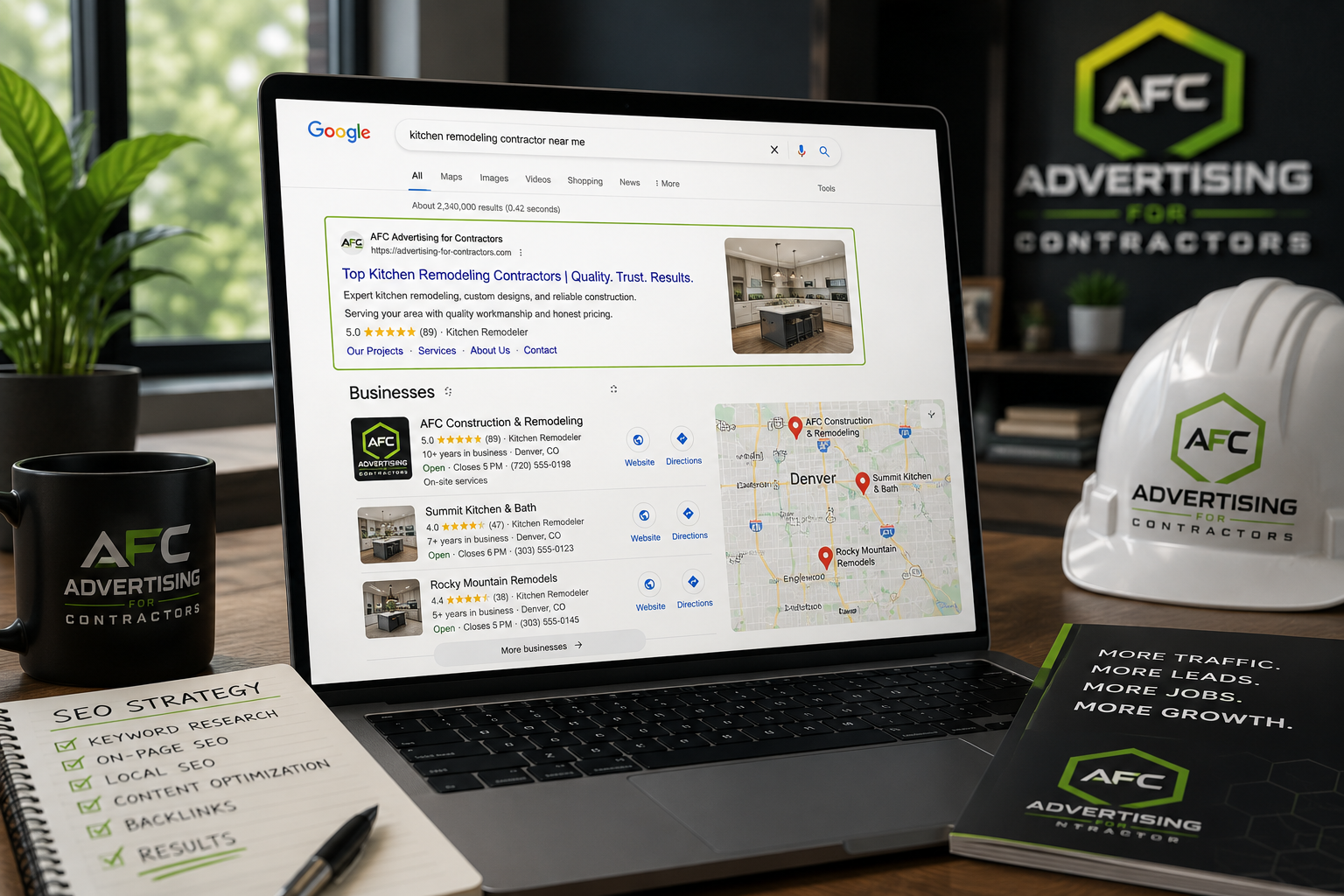
Some of your map is not winnable, and we'll tell you which parts.
If your shop sits on the edge of a metro, or the suburb you want is ringed by four established competitors with three hundred reviews each, no amount of profile optimisation puts you in that map pack. The honest move is to concentrate on the territory you can hold and buy the rest with ads if it's worth it. An agency that promises to rank you everywhere is describing a service nobody can deliver.
Get a free grid scanWhat is included in contractor local SEO?
Profile, reviews, consistency, measurement and the paid layer that fills the gap while the organic position builds. Nothing here takes six months to show a signal, which is what separates local SEO from the broader discipline.
Google Business Profile optimization
Every field in the table above, weighted and worked in order. Category strategy, services listed individually, real job photography, attributes, honest service areas. Movement usually shows within 30 to 90 days because most competitors have done half of it.
See the field weights The biggest leverReview generation systems
An ask that fires after every completed job without anyone remembering to send it, plus response handling for the ones that arrive. Volume and velocity are the main way to widen the circle proximity draws around your business.
Lead generation systems Above the mapLocal Services Ads management
Licence and insurance verification for the Google Verified badge, category setup, budget pacing and the lead disputes most contractors never file. At a blended $53 per lead with a 43.9% book rate, it is the cheapest paid channel in the trades.
Google Ads & LSA ReinforcementService & area page architecture
Real pages for real areas, naming neighbourhoods, local conditions and completed work. The site and the profile reinforce each other, and thin templated pages now drag down the pages that were working rather than just failing quietly.
Contractor SEO MeasurementGeo-grid rank tracking
Position measured across dozens of points in your market rather than one. It is the only way to see whether the circle is widening, and it makes an agency accountable to something more honest than a single flattering ranking screenshot.
Check your radius The next surfaceAI search visibility
The same completeness and consistency work that feeds the map pack is what gets a business surfaced when someone asks an assistant for a recommendation — something roughly 1.2% of local businesses currently manage.
AI search optimizationWhat local SEO can a contractor fix this week for free?
Four things, all free, and together they will move you further in ninety days than a small ad budget would. If you do only these and never call us, this page has done its job.
Check your primary category right now
Two minutes. It is the heaviest field on the profile and it is wrong on a startling number of contractor listings. Match it to your money service, not the broadest label.
Search your keyword from a customer's suburb
Not from the shop. Use a phone on mobile data somewhere you want work, and see whether you appear at all. That result is the honest one.
Add every service individually
Most contractor profiles list two or three and stop. Each one added with its own description is another search you become genuinely relevant to.
Ask your last ten customers for a review
An afternoon of calls, and the cheapest ranking factor you will ever have access to. Then make the ask part of finishing a job rather than a thing you remember.
Where can a contractor verify all this independently?
From Google's own documentation, mostly. Local SEO attracts more folklore than any other part of this field, and almost all of it can be settled by reading the actual guidelines. None of these pay us to be listed.
Google Business Profile Help
The guidelines themselves, including the rules on business names, service area businesses and categories. If an agency suggests something that contradicts this page, that is your answer.
Local Services Ads Help
Setup, the Google Verified badge, and critically the lead dispute process. Most contractors never file a dispute, which quietly inflates their real cost per lead.
Google Search Central
How search works, what structured data does, and what actually breaks the guidelines. The antidote to most of the SEO folklore you will be sold.
Google Search Console
Free, and it shows the real queries bringing people to your site. Most contractors have never opened it, and it costs nothing to find out what you already rank for.
Google Maps Help
Where you report a competitor stuffing keywords into their business name or operating from a fake address. It happens constantly in the trades and it is worth knowing the process exists.
Eye To Ad Media
Our parent company, running local SEO across dozens of geo-targeted verticals since 2012. Listed with the interest declared — the work behind this page is theirs.
Contractor local SEO questions
Why does my contractor business rank in some areas but not others?
Does setting a bigger service area help me rank further away?
How do I get into the Google map pack as a contractor?
How much do Local Services Ads cost for contractors?
What happened to Google Guaranteed?
How many reviews does a contractor need to rank locally?
Should a contractor use a home address or a service area business?
Is local SEO or Local Services Ads better for contractors?
More plain-English definitions in the contractor marketing glossary.
See your real map, not the one from your office
We run a geo-grid scan of your actual market and show you where you rank at each point, alongside your profile, your review position against the map pack leaders, and the listings you have forgotten about. Most contractors have never seen their own coverage drawn out, and it is usually the most useful thing in the audit.
About a day to turn around. You keep the findings whether you hire us or not, and there is no obligation. If parts of your map are not realistically winnable, we will show you which and say so rather than sell you a plan to chase them.
Prefer to talk? 1-800-481-8638 — a person answers. Or email info@eyetoad.com.
Request your free grid scan
No cost, no contract, no pitch deck.
Find out where you actually show up.
One call. We'll scan your market, show you the real coverage, and tell you which parts are worth fighting for. If some of it isn't, we'll say so.