The best marketing for contractors starts with a fit.
We work with contracting companies that want to scale and are willing to invest consistently to get there. We're a poor match for anyone hunting a thirty-day miracle. Being blunt about that upfront saves us both a bad six months — and it's the reason our clients stay without a contract holding them there.
What is the best marketing for contractors?
There isn't one. The best marketing for a contractor is whichever channel delivers leads below your break-even cost per lead in your market, at the volume your crew can actually absorb. That answer changes with your trade, your ticket size, your close rate and your service radius — which is exactly why anyone who names a single channel before asking about your business is guessing.
Here's what that looks like in practice. A plumber with a $1,714 average ticket and emergency intent can win on Local Services Ads, where the February 2026 benchmark put plumbing leads near $57 apiece at a 44.5% book rate. A pool builder working six-month sales cycles and six-figure projects cannot — that customer is researching for months and needs content, proof and nurture, not a click-to-call button.
Meanwhile a painter working one town at a $2,800 average job may get everything they need out of a properly finished Google Business Profile and a review system, at almost no cost. Selling that painter a $3,000 monthly retainer would be malpractice, and we've told people so.
The best strategy is the one your numbers support. Everything else is a preference.
So the first conversation we have with any contractor is about arithmetic, not tactics. What does a job invoice at? What's left after materials and labor? How many estimates turn into work? Those three numbers produce your ceiling, and the ceiling decides everything downstream. You can run them yourself on the break-even worksheet before you ever speak to us.
Which problem do you actually have?
"We need more customers" is three completely different problems wearing one sentence, and they have three completely different fixes. Spending money on the wrong one is how contractors conclude that marketing doesn't work. Pick the one that sounds most like your week.
You have a visibility problem
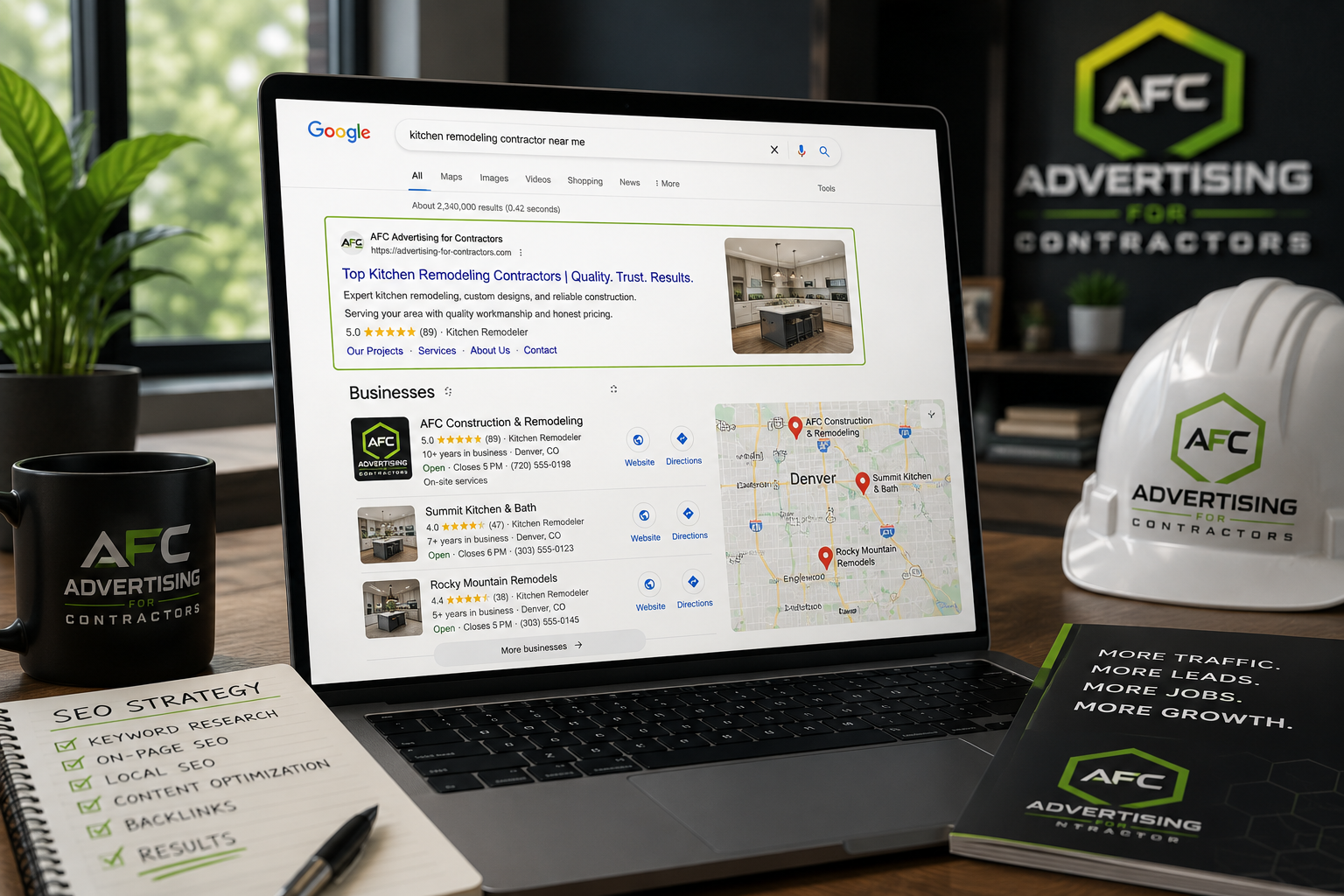
The fix lives in search. Homeowners looking for your trade are typing into Google, tapping the map pack, and increasingly asking an AI assistant to recommend someone. If you aren't in those three places, you don't exist to them — regardless of how good your work is.
Where we'd start: Google Business Profile first, because it's the highest-leverage free asset in local marketing and most contractor profiles are barely half filled in. Correct primary category, complete services, real job photos, and a review system that produces a steady trickle rather than an old pile. Then paid search or Local Services Ads for immediate volume while organic rankings build underneath.
Honest timeline: map pack movement in 30–90 days. Competitive organic terms take four to eight months. Paid moves in days, which is why we usually run both.
Read next: local SEO for contractors · contractor SEO · Google Ads for contractors
You have a conversion problem
This is the expensive one to misdiagnose, because the instinct is to buy more traffic — which just means paying to send more people to a page that already isn't working. If your site converts at 1% and you double the visitors, you've doubled the cost of the same result.
Where we'd start: the phone number in the header on every page, a form short enough that someone fills it in from a truck, real photos of your actual crew and actual jobs instead of stock images, visible reviews, and page speed that doesn't lose people before the page renders. None of that is glamorous. All of it moves the number.
Why it matters more than volume: going from 1% to 3% on the traffic you already have triples your leads at zero additional ad spend. That's the cheapest growth available to most contractors, and it's the work most agencies skip because it isn't billable monthly.
Read next: score your website · contractor lead generation · get a free audit
You have a follow-up problem
And it's the cheapest of the three to fix, because it usually costs nothing but a change in habit. Leads that sit go cold fast. A homeowner who filled in three forms on a Tuesday night is talking to whoever calls back first, and it is almost never the contractor who waited until Thursday.
Where we'd start: instant lead alerts to a phone rather than an inbox nobody checks, a defined person responsible for calling back, and a simple follow-up sequence that fires whether or not anyone remembers. Then call tracking, so you can hear what actually happens when someone picks up.
The uncomfortable part: if this is your problem, more marketing makes it worse. You'd be paying to generate leads that die in the same gap. Fix the intake first — we'll tell you to do that before we'll take your money for traffic.
Read next: lead generation systems · how we report on booked jobs
Not sure? That's a normal answer. Tell us what your week looks like and we'll work it out with you.
What stage is your contracting business at?
Growth stage changes the right answer more than trade does. A one-truck operation and a company running four crews across three counties need genuinely different strategies, and the mistake most contractors make is buying the strategy that belongs to the stage above or below theirs.
One truck, one town
Referrals carry most of the work. The goal is being findable when someone checks you out after hearing your name. Google Business Profile, reviews, a site that loads fast and says what you do. Budget in the low hundreds, sometimes less. Anyone quoting you thousands here is selling.
Two to four crews
Referrals no longer fill the calendar and the slow months hurt. Now you need a channel that produces work on demand. Paid search or Local Services Ads for immediate volume, local SEO compounding underneath, and tracking so you can see which is which.
Multi-city coverage
You're competing with regional players and defending a service area rather than a town. Service area pages, multiple profiles where they're warranted, competitor gap analysis, and content that establishes you as the obvious choice before anyone requests a quote.
Scaling toward dominance
Marketing is a department, not a line item. Full paid and organic coverage, AI search visibility, brand campaigns that make branded search cheap forever, and reporting infrastructure that ties spend to booked revenue by channel and by market.
How do we decide whether to take an account?
Three questions, asked in this order. Every one has to clear. If any fails we say which, because a contractor who understands why they were turned down can usually fix it and come back — and several have.
Do the numbers work?
Your break-even cost per lead against what channels actually cost in your trade. If your ceiling sits below the cheapest verified channel, paid acquisition loses money on the first job no matter who runs it. That is arithmetic, not effort — and no agency can out-work it.
When this is the failure, the fix is upstream: raise your average job value, improve your margin, or lift your close rate. We will tell you which lever moves your ceiling furthest, and you can go and do it without us.
Is the market winnable?
Some markets are locked up by national franchises spending more per month than a regional contractor turns over. Some organic terms have entrenched competitors eight years deep. We look at who currently holds the map pack and the paid auction, and we estimate honestly how long it would take and what it would cost to displace them.
Sometimes the answer is that it is not worth it, and the better play is a narrower geographic focus or a different service line. We would rather say that in week one than in month eight.
Is there a conflict?
We do not take two contractors in the same trade competing for the same service area. Ever. It would mean bidding against ourselves in the same auction and splitting our attention between two people who both deserve all of it.
If we already serve your trade in your market, we say so on the first call rather than taking the account and managing the conflict quietly. You should ask any agency this question, and you should be suspicious of a vague answer.
All three clear and we quote. The quote is a real number scoped to your market, not a package tier, and it comes with the honest runway attached — see how pricing works.
Are we the right agency for your company?
We take on a deliberately small number of contractor accounts so that every one gets real attention. That means saying no fairly often, including to companies we could technically help. Here's the honest filter.
We're a strong fit if
- You want to grow the business, not just fill next week
- You know roughly what a job invoices at and what you close
- Someone answers the phone quickly — marketing can't fix a voicemail box
- You can commit to a realistic runway rather than judging month one
- You'd rather hear an uncomfortable number than a flattering one
- You want to own your leads instead of renting them indefinitely
- You're willing to send us job photos and answer questions about your trade
We're probably not for you if
- You need the phone ringing this week with nothing built — buy leads first, honestly
- You want a guarantee of page one; nobody controls Google's algorithm
- Leads sit for a day or two before anyone calls back
- You're shopping purely on price regardless of outcome
- You want to sign, disengage, and never open a report
- Your average job is small, margins are thin, and close rate is low — the math may not clear
That last one on the right is real and worth saying plainly. If your break-even cost per lead lands under about $40, most paid channels won't work for you at any agency, because the benchmark costs sit above your ceiling. In that situation the honest advice is to raise your average ticket, improve your close rate, or focus entirely on free channels. We'd rather tell you that than take a retainer for six months. Run the plan builder and it will tell you the same thing without a sales call.
A bad six months costs you more than a lost sale costs us.
Every agency can technically take every account. The ones that do end up managing conflicts quietly, spending budgets that were never going to clear, and reporting activity because they cannot report results. We would rather lose the quote and keep the answer straight.
Find out where you land
What do we need from you?
Three things: fast lead response, honest numbers, and enough time for the work to compound. None of them cost money. All of them decide whether the campaign works.
Answer leads fast. This is the single biggest variable we don't control. A lead we generate on Tuesday and you call on Thursday is worth a fraction of the same lead called back in ten minutes. If your phone coverage is genuinely a problem, tell us — we can help with call handling and after-hours routing, but we can't paper over it with more traffic.
Tell us the real numbers. If you inflate your close rate to look good in the first meeting, we'll build a plan on a false ceiling and both of us will be confused in month three. Nobody here is judging a 15% close rate. We just need the true one.
Give it a runway. Paid channels move in days. Local and organic compound over months. If you can only commit to thirty days, we'll point you at paid and skip the rest — that's the honest recommendation, even though it's the smaller sale.
In return: no long-term contract, monthly reporting on leads and booked jobs by source, and a straight answer when something isn't working. More on how we operate.
Which contractors and which markets?
Ten trades, and any market in the United States, Canada or internationally where we think we can realistically win. We're headquartered in Denver, Colorado, but geography matters far less than whether the numbers work and whether the competitive field is beatable.
Roofing
Storm response, insurance work and replacement demand. The widest spread in cost per lead of any trade, which makes market-level strategy unusually important.
Roofing marketing Highest emergency intentPlumbing
The most urgent search behavior in the trades and the highest click costs to match. Speed to lead decides more here than almost anywhere else.
Plumbing marketing Most seasonalHVAC
Demand follows the thermometer, so budget planning matters as much as campaign quality. Maintenance agreements change the lifetime value math entirely.
HVAC marketing Lowest cost per leadElectrical
Panel upgrades, EV charger installs and service work. The cheapest verified leads of the major trades, and still underserved by good marketing.
Electrical marketing Longest sales cycleSolar
High ticket, long consideration, heavy competition from lead brokers. Content and nurture matter more than click volume.
Solar marketing Broadest scopeGeneral Contracting
Referral-heavy by nature, which makes the digital presence a closing tool as much as a discovery one. Portfolio and proof carry the weight.
General Contracting marketing Volume tradePainting
Lower tickets and lower lead costs, which puts the emphasis on efficiency and repeat work rather than aggressive spend.
Painting marketing Financing-sensitiveRemodeling
Kitchen and bath projects with long decision windows and two decision-makers. Offering financing at the point of sale often moves close rate more than anything upstream.
Remodeling marketing Seasonal, high ticketPool Builders
Six-figure projects researched over months. Search demand arrives long before the buying decision, so early capture matters more than closing speed.
Pool Builders marketing Fastest closeFencing
Short decision cycles and strong neighbourhood clustering — one visible job frequently produces the neighbours. Job-site signage and review velocity punch above their weight.
Fencing marketingNot on the list? The arithmetic is identical for any trade — landscaping, concrete, masonry, garage doors, gutters, septic and the rest all work the same way, they just have no published cost-per-lead benchmark, which the plan builder states plainly rather than papering over. If you're not a contractor at all, the parent agency covers most other industries — see industries beyond contracting.
Working with AFC
What is the best marketing strategy for contractors?
Do you have a minimum budget?
Will you work with my competitor in the same city?
How do you decide whether to take an account?
How quickly do I need to respond to leads?
What if I already have a marketing company?
Do you work with commercial contractors or only residential?
What happens if it is not working after a few months?
Let's find out if we're a fit
Tell us about your business and we'll audit your website, your Google Business Profile, your review profile and the competitors currently outranking you — then tell you honestly whether we're the right call.
If we're not, we'll say so and point you somewhere useful. You keep the audit findings either way. It takes about a day and there's no obligation attached.
Rather talk it through? 1-800-481-8638 or info@eyetoad.com.

Request your free audit
No cost, no contract, no pitch deck.
If the numbers work, let's talk.
And if they don't, we'll tell you that instead. One call, a real number, no pitch deck.