
Ranking first stopped meaning first.Here's what the page looks like now.
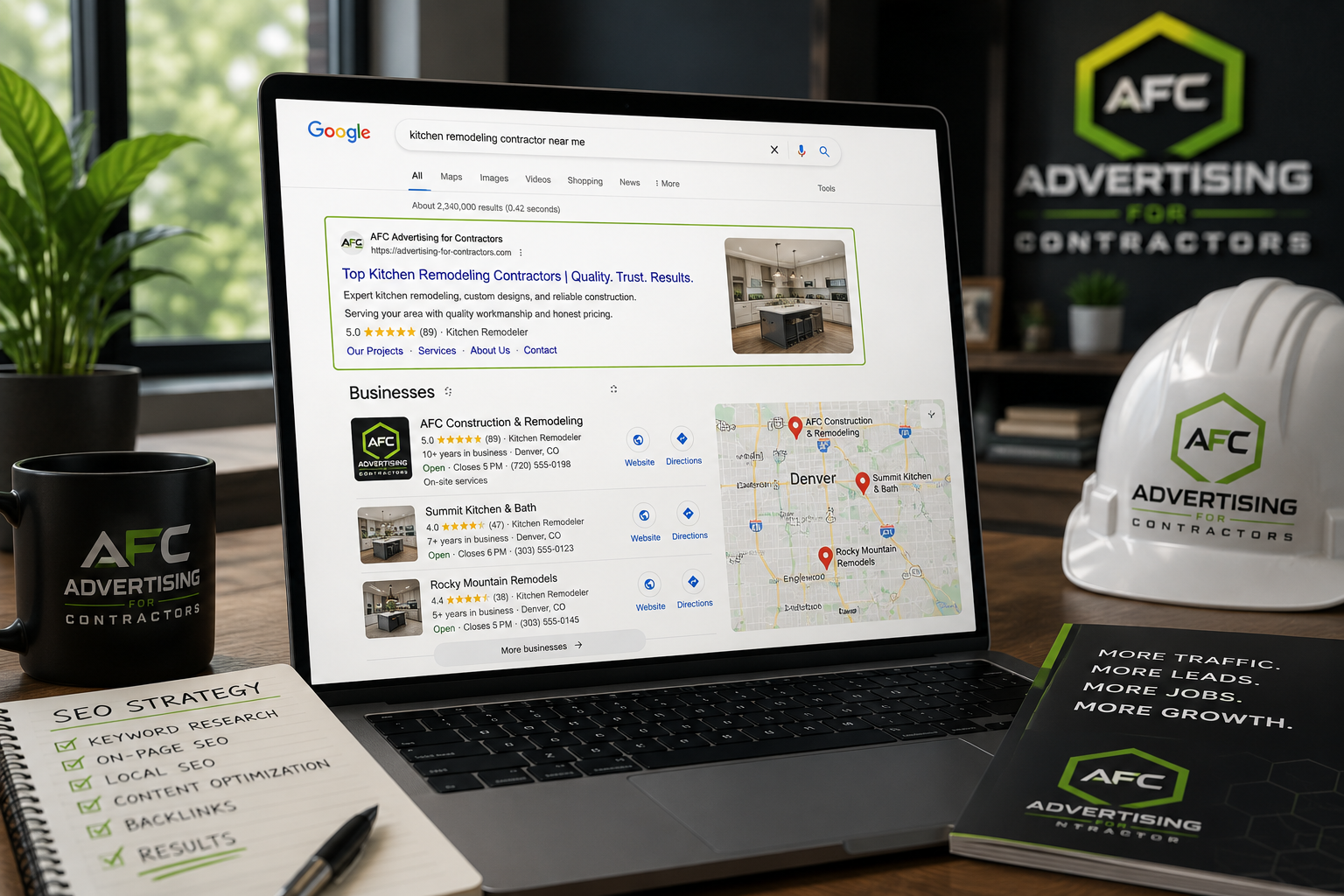
A homeowner searching for your trade sees an AI answer, then paid ads, then three map listings — and only then the organic results everybody still calls “number one”. Position one on a page nobody scrolls to is not a ranking. Contractor SEO now means earning a place in the parts of the page that are actually visible, and being one of the sources the AI answer is built from.
Sources: Seer Interactive analysis of paid click-through where AI Overviews are present; 2026 research on local business visibility and conversion in AI-generated answers; SearchLight Digital contractor advertising benchmarks, February 2026, drawn from $6.72M in tracked Local Services Ads spend across 888 contractors. These are cross-industry and cross-trade figures — your market, your trade and your review profile will move all four meaningfully.
What does contractor SEO actually mean in 2026?
Getting into the visible parts of a results page that no longer leads with organic listings. That means the map pack first, because it sits highest and home service searches are overwhelmingly local. Then being a source the AI answer quotes. Then the organic listing itself, which still matters enormously but arrives further down the page than it used to. Any agency still selling you “position one” as the whole objective is describing a search results page that stopped existing.
The map pack outranks everything
Three listings with a map, sitting above the organic results, and for most home service searches it is where the clicks and calls go. It is driven by your Google Business Profile, your categories, your reviews and your proximity — not by your website's authority.
Traffic is a vanity number
Visits are not jobs. A contractor ranking for how to fix a leaky tap gets more traffic than one ranking for emergency plumber plus a suburb, and far fewer calls. We measure the searches attached to work you actually want.
Being cited beats being clicked
When an AI answers a homeowner's question, it names sources. Getting named is now a ranking outcome of its own, and roughly 1.2% of local businesses manage it — which makes it the least crowded position on the page.
Reviews are ranking infrastructure
Review count and velocity feed local rankings directly, which makes asking every finished customer the highest-return unpaid task in contractor marketing. It is also the one almost nobody does consistently.
Thin pages now actively hurt
Forty service area pages built by swapping a town name into a template were a shortcut a decade ago. Today they get discounted by search engines and skipped entirely by AI systems, and they drag on the pages that were working.
It compounds, or it does nothing
SEO is the only channel where month twelve costs the same as month one and produces several times more. That is the entire argument for it — and it is also why stopping at month two guarantees you get nothing at all for the money.
Which searches are actually worth ranking for?
The ones attached to a job, which is not the same as the ones with volume. We sort every keyword into four tiers by what the person searching is about to do. Most contractor websites are accidentally optimised for tier three, which is exactly why their reports show traffic climbing while the phone stays quiet.
Low volume, highest conversion, most expensive to buy. Someone with a problem happening right now and no interest in comparing three quotes. Almost always a map pack and Local Services Ads fight rather than an organic one, because the searcher never scrolls.
Real intent, weeks out, and the single most under-served tier in every trade we work in. Contractors avoid publishing prices, so the results are dominated by national averages that are useless locally. Honest local ranges here both rank and pre-qualify every caller.
High volume, months out, and where AI answers are hitting hardest — often the homeowner never clicks through at all. Still worth writing, because these are the questions AI systems assemble answers from, and being the cited source is how you get named later.
DIY guides, job seekers, students, other contractors. Genuinely large traffic numbers and close to zero commercial value. This is the tier that makes an agency report look impressive while your schedule stays empty.
One practical consequence worth stating plainly: a good SEO report should show some metrics going down. If we cut tier four traffic and grow tier one and two, total sessions may fall while calls rise. An agency that only ever shows you numbers going up is choosing which numbers to show you.
When does SEO get cheaper than buying clicks?
Later than any agency wants to admit, and then permanently. Paid search delivers leads in week one at a cost per lead that stays flat or rises with the auction. SEO delivers almost nothing for months, then produces more each month at the same spend. Put your real budgets in and the chart will show you the month the lines cross — including the stretch where paid is straightforwardly winning.
The Compounding Crossover
AFC · No. 015
Runs entirely in your browser. Nothing is stored or transmitted. This is a model, not a forecast, and we would rather you treated it as one: it assumes an S-curve ramp typical of what we see, a paid cost per lead that drifts up about 4% a year with auction pressure, and a flat SEO spend. Nobody can honestly predict your ramp — the market, your starting position and your review profile all move it. Use it to understand the shape of the trade-off, not to plan a budget to the dollar.
What does a contractor SEO project actually involve?
This sequence, deliberately front-loaded with the things that are free or fast. If we can move your map pack position in ninety days while the slower work compounds underneath, you get a return long before the organic rankings arrive.
Google Business Profile and reviews
Correct primary category, every service listed, real job photos, service areas that match where you actually work, and a review request that fires after every completed job. This moves faster than anything else available to a contractor and it costs nothing but consistency. Detail is on the local SEO page.
Fix what is leaking
Site speed on a phone, because your customer is standing in a yard on mobile data. Click-to-call that works. Forms that submit. Tracking installed before a dollar goes anywhere. There is no point ranking a page that cannot convert, and technical faults are usually the cheapest fix on the whole account.
One real page per service
Not a services list. A page per money service, written to what a buyer asks: what it costs, how long it takes, what goes wrong, what you actually do. These are the pages that rank for tier one and tier two, and most contractor sites collapse all of them into a single paragraph on the homepage.
Service areas, honestly scoped
A page for each area you genuinely serve, naming neighbourhoods, local conditions, permit rules and jobs completed there. Five real pages outperform forty templated ones, and the templated approach now drags down the pages that were working rather than just failing quietly on its own.
Cost content and the questions nobody answers
Local price ranges, timelines, permit realities, what makes a quote go up. This is tier two territory, it is nearly unclaimed in every trade, and it is the content AI systems assemble answers from — which is currently the least crowded position on the results page. See AI search optimization.
Report on jobs, not rankings
Calls and forms attributed to source, and where possible booked work. A ranking report is not a result, it is an input. If tier four traffic falls while tier one calls rise, we will show you both and explain why the first number went the right way by going down.
If you can't fund six months of it, don't start.
SEO compounds, which is a polite way of saying it gives you almost nothing early. A contractor who spends three months on it and stops has bought nothing at all — the money would have produced more work as paid search. We would rather tell you that on the first call than take three months of fees and hand you a ranking report. If the runway isn't there yet, start with ads and come back to this when it is.
Get a free SEO auditShould a contractor choose SEO or Google Ads?
Both, in sequence, and the order depends entirely on your cash position. Paid search is a tap: turn it on, leads arrive this week, turn it off and they stop the same afternoon. SEO is a well: months of digging, then water at a cost that stops rising. The mistake is treating them as competing options rather than as two different time horizons.
Paid search
The right first move for most contractors with an empty schedule. We set it up regularly and it does exactly what it says.
- Leads within days, which matters when crews are idle
- You control pacing, geography and which services get budget
- Cost per lead is knowable up front and scales predictably
- Rises with auction pressure and you absorb all of it
- Stops producing the afternoon the card gets declined
- Builds no asset — month twelve starts from zero again
Search engine optimization
Rankings, map position, reviews and content. Months to build, then it keeps producing without a per-lead charge.
- Cost per lead falls as the asset matures instead of rising
- The map pack sits above the ads for most home service searches
- Content earns AI citations that paid search cannot buy
- Branded search stays cheap forever once people know your name
- Four to eight months before it carries real weight
- Worthless if you stop at month two — genuinely, entirely worthless
Ads buy you this month.
SEO buys you every month after.
What SEO can a contractor fix this week for free?
Four things, none of which need an agency, and together they will move you further in ninety days than a small paid budget would. If you do only these and never call us, this page has done its job.
Check your primary category
The single highest-leverage field on your Google Business Profile, and it is wrong on a startling number of contractor listings. Pick the one that matches your money service, not the broadest one.
Ask your last ten customers for a review
An afternoon of calls. Review count and velocity feed local rankings directly, and this is the cheapest ranking factor you will ever have access to.
Load your site on your own phone, on mobile data
Not on the office wifi. Time it. If it takes more than a few seconds or the phone number isn't tappable, that is costing you more than any ranking problem.
Search your own money keyword incognito
See the page your customer actually sees — who owns the map pack, whether an AI answer appears, and how far down the organic results start. That is your real competitive picture.
Where should a contractor learn SEO independently?
From the people who build the systems, not from agencies selling against them. None of these pay us to be listed, and between them they will let you verify or dismiss most of what any SEO company tells you.
Google Search Central
Google's own documentation on how search works, what structured data does and what actually violates their guidelines. The antidote to most SEO folklore, and free.
Google Business Profile Help
The setup documentation for the single most important asset in contractor SEO. If you only read one thing on this list, read the guidelines on categories and service areas.
Google Search Console
Free, and it shows you the actual queries bringing people to your site. Most contractors have never opened it, and it answers the tier question on this page with your own data.
PageSpeed Insights
Google's own speed and Core Web Vitals test. Run your homepage and your busiest service page through it before you pay anyone to tell you your site is slow.
Schema.org
The structured data vocabulary that search engines and AI systems read. Dry, but it is the actual specification rather than somebody's interpretation of it.
Eye To Ad Media
Our parent company, running SEO across dozens of local verticals since 2012. Listed with the interest declared — but the work behind this page is theirs, so you may as well see it.
Contractor SEO questions
How much does contractor SEO cost?
How long does SEO take to work for a contractor?
Is SEO or Google Ads better for contractors?
Do AI Overviews mean SEO is dead for contractors?
What keywords should a contractor target?
How many service area pages should a contractor have?
Can I do contractor SEO myself?
What is the difference between SEO and local SEO for contractors?
More plain-English definitions in the contractor marketing glossary.
See the page your customers actually see
We audit your website, your Google Business Profile, your review profile and the contractors currently above you — then we show you the real results page for your money keyword, including who owns the map pack and whether an AI answer is taking the click before anyone reaches you.
About a day to turn around. You keep the findings whether you hire us or not, and there is no obligation. If we think your budget is better spent on paid search for now, we will say that instead of selling you an SEO retainer.
Prefer to talk? 1-800-481-8638 — a person answers. Or email info@eyetoad.com.
Request your free SEO audit
No cost, no contract, no pitch deck.
Traffic isn't the job. Jobs are the job.
One call. We'll show you the real results page for your market, tell you what it takes to get onto it, and give you a straight number. If SEO isn't the right spend yet, we'll say so.